
No. A larger oil seal interference does not automatically produce better sealing. The purpose of interference is to establish an appropriate contact condition between the sealing lip and shaft. Once the contact becomes excessive, the additional radial force can increase friction, heat generation and wear instead of improving the seal.
This is particularly important for rotary oil seals because the shaft is continuously moving against the sealing lip. A static gasket can be compressed heavily without experiencing continuous sliding friction, but a rotary lip seal has to work under relative motion. Shanfeng points out that the heat generated at the lip and shaft interface is an important limitation for rotary sealing performance, especially as speed and other loads increase.
Consider two oil seals installed on the same shaft. If Seal A has a properly designed interference and Seal B has substantially more interference, Seal B may initially appear to have a tighter contact. However, the higher radial force can increase the frictional load at the lip. During continuous rotation, this friction becomes heat. If the heat cannot be dissipated effectively, the lubricant film at the interface can deteriorate and the sealing material may age more quickly.
The problem can become more noticeable at high shaft speeds. As rotational speed increases, the sealing lip has less time to dissipate the heat generated by sliding contact.
There is another reason why simply increasing interference is not a reliable solution: sealing depends on contact pressure distribution, not only contact pressure magnitude. Lip angle, flex-section stiffness, spring tension and the shape of the sealing edge all influence how the pressure is distributed along the contact area.
The shaft itself matters as well. If the surface finish is unsuitable, excessive interference may increase wear without correcting the underlying surface problem. Shaft runout or shaft-to-bore misalignment can create another type of sealing problem that cannot be solved simply by making the lip tighter.
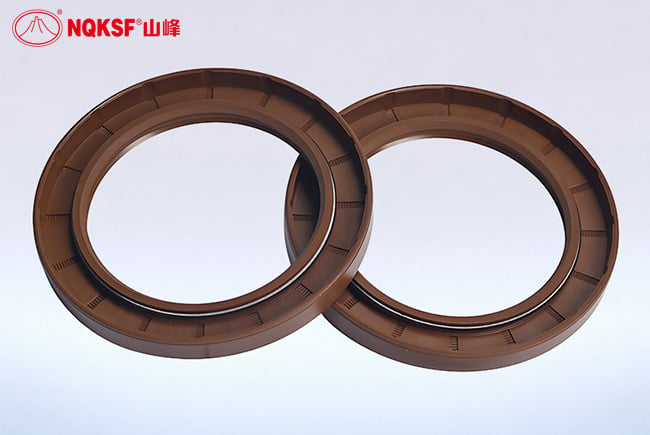
This is why experienced seal designers normally look for a balanced interference value rather than the largest possible one. The seal needs enough radial force to maintain the sealing interface under actual operating conditions, but not so much that friction and temperature become unnecessarily high.
In practical terms, a good oil seal should not be judged by how tightly it grips the shaft when the machine is stopped. Its real performance is determined by what happens after hours of rotation, when the lip, lubricant, shaft and heat generation are interacting continuously. The correct interference is therefore the one that supports stable sealing under the intended working conditions—not simply the one that produces the strongest initial contact.
 Hot News
ShanFeng Special Rubber Products Co., Ltd., operating under brand NQKSF since 1990, is a global leader in the sealing industry.
Copyright © 2026 ShanFeng Special Rubber Products Co., Ltd. All rights reserved. Privacy Policy
 EN
EN